
Why Smaller Spirits Bottles Are Gaining Attention in 2026
From mini spirits to half bottles, smaller formats are seeing sales growth as shoppers seek lower upfront prices, smaller portions, and opportunities to try new brands.
Published on:
October 16, 2026
Published By:
MHW Mark
Smaller bottles are gaining attention in the U.S. spirits market. While the traditional 750 mL bottle remains a familiar option, research published in 2025 and 2026 shows that smaller formats, particularly in spirits, are performing well as consumers rethink how much they spend and purchase.
In a September 2026 interview with ECRM, NielsenIQ’s Director of Beverage Alcohol Thought Leadership, Kaleigh Theriault, said smaller bottles are selling well, possibly because people are buying them to drink at home before going out.
“We do see small sizes in spirits are still one area of growth,” Theriault told ECRM. “The 50 mls and the 100 mls really being something that people are buying a little bit more of, likely to support that pre-drinking occasion.”
Smaller Spirits Bottles Are Seeing Growth
An April 2026 report from Consumer Edge found that U.S. spirits dollar sales were growing faster in smaller formats than in standard and larger bottles.
The report examined sales trends dating back to 2022, showing that smaller bottle sizes have been outperforming larger formats for several years. Growth in 375 mL bottles accelerated further in early 2026.
In the most recent 12-week period analyzed, dollar sales of 375 mL spirits bottles increased 9.2% compared with the same period in 2025, while 50 mL bottles grew 8.7%. By comparison, 750 mL bottles declined 2.8%, and 1.75-liter bottles fell 3.8%.
These percentages reflect changes in dollar sales, rather than the number of bottles sold.
These findings suggest that even as the broader spirits market faces slower sales, more consumers may be opting for smaller bottles over larger ones.
*Image from Consumer Edge article linked above*

Why Consumers Are Buying Smaller
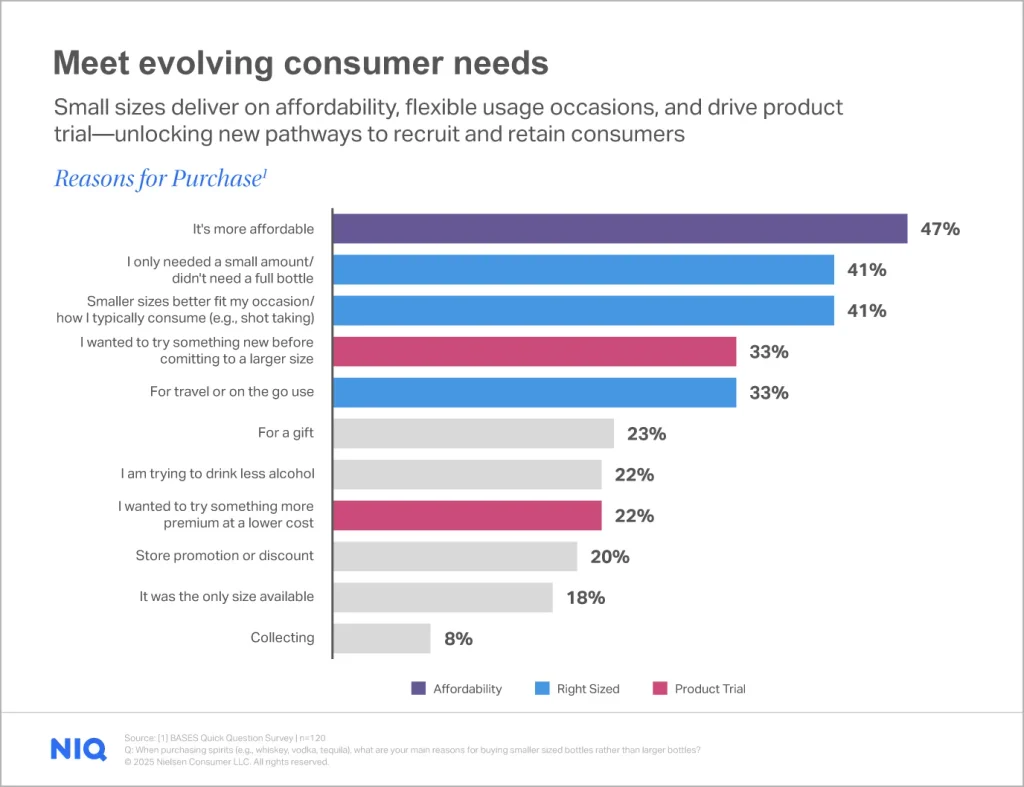
Price is one important factor, but it isn’t the only one. According to NielsenIQ research published in November 2025, 47% of surveyed small-format spirits buyers cited affordability as a reason for their purchases. Another 41% said they only needed a small amount, while 41% said smaller bottles better suited the occasion or how they typically consume spirits. Additionally, 33% wanted to try something new before committing to a larger bottle.
For consumers, a miniature or half bottle can offer a lower upfront purchase price, even if it costs more per ounce than a full-size bottle. Smaller formats also provide an opportunity to try a premium spirit without committing to the price of a standard bottle.
A separate September 2026 NielsenIQ report on U.S. consumer shopping habits pointed to smaller households, rising living costs, and more frequent shopping trips as reasons consumers are moving away from buying large packages to stock up at home.
*Image from NielsenIQ article linked above*
What This Means for Beverage Brands
Taken together, these sales figures and consumer findings suggest that bottle size is becoming an important purchasing consideration for spirits consumers.
For beverage brands, there are several potential benefits. Smaller formats can help brands offer a lower initial purchase price, encourage trial, and give consumers more options for different occasions. However, introducing another bottle size also involves decisions about packaging costs, production, inventory, and retail availability.
The growth of smaller bottles doesn’t mean they’re the right choice for every product. Brands still need to consider their customers, pricing, and distribution plans before introducing new formats.
At MHW, we support spirits brands with U.S. importation, distribution, compliance, and logistics. Through BrandArc by MHW, we also help brands with product development, bottle design, sourcing, and supply chain planning.
As consumers continue to look for more flexibility in their purchases, the range of bottle sizes available may become an increasingly important consideration for beverage brands.