
U.S.-Canada Alcohol Trade Dispute: What Has Changed in 2026?
New U.S. import restrictions on Canadian wine and spirits follow more than a year of Canadian limits on American alcohol sales.
Published on:
October 27, 2026
Published By:
MHW Mark

The ongoing trade dispute between the United States and Canada means that wine and spirits businesses in both countries now face higher import taxes and bans on certain products.
On September 29, 2026, the U.S. began blocking imports of certain Canadian alcoholic beverages, following new 50% tariffs introduced in August. These measures came after Canadian provinces removed American wine, spirits, and other alcoholic beverages from their stores in 2025.
MHW is the only service importer on the Board of Directors of the Distilled Spirits Council of the United States (DISCUS), a trade association representing the U.S. spirits industry. DISCUS has supported calls for the U.S. and Canada to negotiate an end to the restrictions, return American wine and spirits to Canadian stores, and restore tariff-free trade.
Here’s how the dispute began, what the new restrictions cover, and how beverage businesses are being affected.
How the Dispute Began
In March 2025, several Canadian provinces stopped selling U.S.-made alcoholic beverages in response to American tariffs on Canadian goods.
Ontario was among the first to act. On March 4, the province’s government-run liquor agency, the Liquor Control Board of Ontario (LCBO), announced that it would stop purchasing American alcohol and remove U.S. products from retail stores and online sales channels.
The restrictions covered wine, spirits, beer, cider, and ready-to-drink beverages. At the time, the LCBO carried more than 3,600 U.S. products from 35 states, accounting for up to C$965 million in annual sales.
Other provinces introduced similar restrictions. Alberta and Saskatchewan resumed sales of American alcohol in June 2025, but bans remained in place across most of Canada.
Although the Canadian federal government removed many retaliatory tariffs on U.S. goods in September 2025, the provincial alcohol restrictions continued.

New U.S. Tariffs and Import Restrictions in 2026
The dispute escalated in August 2026, when the U.S. imposed additional 50% tariffs on specified Canadian products, including certain alcoholic beverages.
Canada responded by announcing new tariffs on selected U.S. goods, including products in the steel, dairy, and agricultural equipment sectors.
Even more recently, on September 29, the U.S. added a separate import ban on certain Canadian alcoholic beverages.
According to U.S. Customs and Border Protection (CBP), products covered by the ban are denied entry into the United States. Unlike a tariff, which adds a tax to imported goods, an import ban prevents the products from entering the country.
The ban covers specified wines, spirits, and beers. Where the rules apply to “packaged” beverages, that includes products sold in bottles, cans, boxes, kegs, and similar containers intended for consumption.
Not all Canadian alcoholic beverages are banned. Some products, including certain bulk shipments, may still be imported but remain subject to the applicable 50% tariff.
Whether a product is banned or subject to tariffs depends on its classification under U.S. customs rules and, in some cases, how it is packaged.
MHW helps brands prepare for these requirements by working with customs brokers, gathering the necessary import documents, and coordinating freight and customs clearance for products that are allowed into the U.S.
U.S. Wine and Spirits Exports Have Fallen Sharply
The restrictions were followed by sharp declines in U.S. wine and spirits exports to Canada.
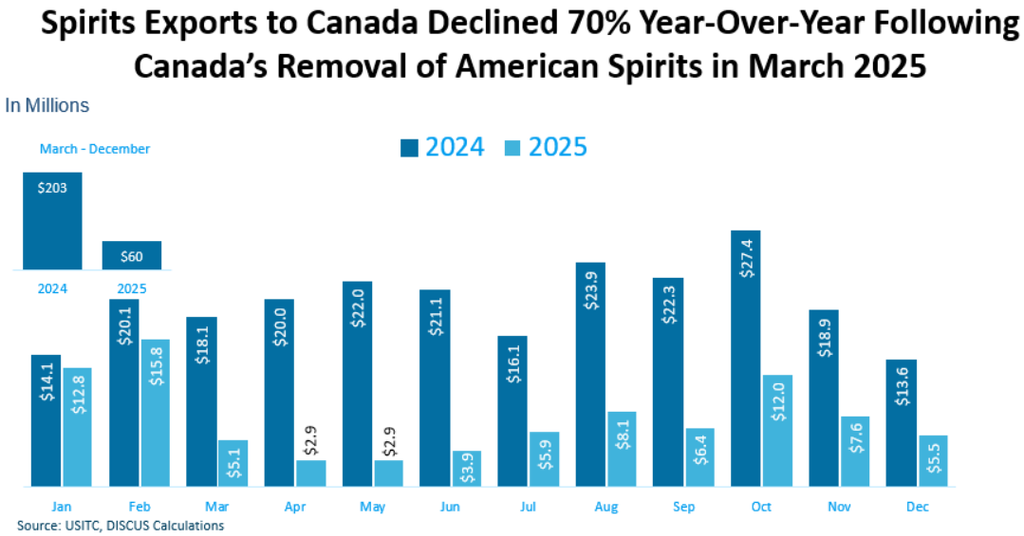
According to the DISCUS, U.S. spirits exports to Canada fell approximately 70% between March and December 2025 compared with the same period in 2024, declining from $203 million to $60 million.
American wine producers experienced similar losses. The Wine Institute reported that U.S. wine exports to Canada dropped 78% between 2024 and 2025, from approximately $460 million to $103 million. Both declines occurred before the September 2026 U.S. import ban.
Canadian distillers also rely heavily on the U.S. market. In a September 29 statement, Spirits Canada reported that approximately 93% of Canada’s spirits export value went to the United States in 2025.
Some Canadian producers are now trying to increase sales within Canada, but selling across provincial borders can be difficult.
Where Things Stand Now
Industry organizations in both countries are calling for the restrictions to be lifted through negotiations.
In a September 29 statement, the Toasts Not Tariffs Coalition, representing U.S. wine and spirits producers, distributors, retailers, restaurants, and other businesses, warned that the restrictions could affect bars, restaurants, and retailers preparing for the holiday season.
In its own September 29 statement, Spirits Canada called for renewed talks between the two governments and a return to tariff-free trade in alcoholic beverages.
Through our role on the DISCUS Board, MHW can bring the perspective of a service importer and the beverage brands we support to industry discussions about trade policy and market access.
The dispute is also facing a new legal challenge. On October 20, BBC News and the Associated Press reported that Gellert Global Group, a New Jersey food importer that buys Canadian cheese, filed a lawsuit in the U.S. Court of International Trade.
Represented by the Liberty Justice Center, the company is challenging the U.S. government’s use of Section 338 of the Tariff Act of 1930 to impose 50% tariffs on Canadian products.
The lawsuit argues that newer trade laws limit the president’s authority to use this provision. It also claims that the government failed to follow the law’s required 30-day waiting period before imposing tariffs on certain products.
The company is asking the court to block the tariffs and order refunds, with interest, for importers that have already paid them.
The Trump administration has said the tariffs are intended to address Canada’s unequal treatment of American products, including alcoholic beverages. The court has not yet ruled on the challenge, and the tariffs and import restrictions remain in effect.
What This Means for Beverage Brands
As of today, American wine and spirits producers still face restrictions on selling their products in most Canadian provinces. Canadian brands exporting to the U.S. must determine whether their products are banned or subject to the new tariffs.
For importers, that means checking the rules for each product before arranging shipments, including its customs classification and packaging.
At MHW, we help wine and spirits brands with U.S. importation, compliance, logistics, and distribution. Our services include preparing customs documentation, coordinating international freight, managing customs clearance, and arranging warehousing and distribution.
We also work with customs brokers to help brands address import requirements and prepare their shipments in line with current rules.
If you’re planning to bring wine or spirits into the U.S., contact MHW to discuss your importation, customs, and logistics needs.